Don't Forget the Butterflies
by Shelby Adams
Geography and Population
Habitat for the bay checkerspot consists of serpentine outcrops in the San Francisco Bay area, ranging from Twin Peaks and Contra Costa County through Santa Clara County at their peak. However, populations have now gone extinct in Contra Costa County, Alameda County, San Francisco County, Buri Buri Ridge, Pulgas Ridge, ad Redwood City. This is largely due to metapopulations, or populations that can exchange dispersing individuals, resulting in "interdependent extinction and colonization processes". Five core areas for the bay checkerspot exist today in San Francisco peninsula, San Mateo County, and Santa Clara County, and two of these groups have been identified as metapopulations (Santa Clara and San Mateo). The exact population of the species is difficult to quantify, as it fluctuates largely from year to year due to weather conditions (Elam).The Bay Checkerspot Butterfly (Euphydryas editha bayensis) is a threatened species which resides mainly in the San Francisco Bay area. It is a subspecies of the Nymphalidae family, and can be distinguished by its red, yellow, and white spots with black bands on its veins and upper wings, and a wingspan of about 2 inches. The insects' life cycle typically spans about one year, and depends largely on the host plants, the main ones being Plantango erecta, Castilleja exserta, and Castilleja densiflora. The emergence, feeding, and mating of the butterflies depends on these plants; without them they cannot lay eggs. Male butterflies can mate multiple times, while females will only mate once (Elam).
Listing
The Bay Checkerspot Butterfly has been listed as a threatened species, since June 18, 1987 (EPA). Although they are not endangered at the moment, the species is likely to become so if current conditions persist. One of the main causes of the listing is habitat loss and degradation brought on by the emergence of non-native plants such as Italian rye grass through nitrogen-deposition. Habitat loss and degradation has also been caused by urban development of the area, freeway construction being on of the largest issues. Smaller populations of bay checkerspots are more susceptible to weather fluctuations such as drought, which has been a common occurrence throughout California in recent years. Overgrazing from livestock has also been a cause for decline, as the animals take away from the butterflies' habitaT (Elam).
In addition to the reasons for the species' listing, remaining bay checkerspot populations are in a constant battle for survival due to multiple factors. Habitat loss and degradation continues to be a large threat to their survival as current and proposed construction projects for housing, road maintenance, and recreation adversely affect the serpentine habitat. Invasive grassland species have become a more prominent threat to the butterflies, the major detrimental plants expanding to include Yellow Star Thistle and certain species of eucalyptus. These impacts are increased by the fertilization (possibly through pollution) and watering of these plants, which in turn suppress the native species. Grazing and fires have emerged as a threat, again by reducing the native plant population and habitat for the bay checkerspot. The use of pesticides near habitat areas are "likely to be at risk from pesticide drift", and spraying directly on populations has occurred in the past. The species has the potential to be sensitive to climate change, mainly temperature and rainfall fluctuations, both of which have been occurring with more frequency throughout California. Reports of illegal collecting have been documented by the US Fish and Wildlife Service, and has had a large impact on smaller bay checkerspot populations, whose reduction in numbers has a larger impact than more established groups. Finally, butterfly roadkill has severely increased in recent years, as roads are constructed closer and closer to the insects' habitat (Elam).
There are multiple resources available to the public to help the recovery of the Bay Checkerspot Butterfly, all of which are relatively simple. Those who reside in the bay area can volunteer with local conservation groups, including Friend of Edgewood and the San Mateo County Parks and Recreation Foundation (Friends of Englewood). If the space is available, planting butterfly gardens with native plants in residential communities and backyards could help to boost the population. Reducing emissions by driving less and in the appropriate manner is beneficial to the species as well as other wildlife in the area, and as always donating to research organization such as the FWS and those mentioned above can contribute a great deal to the resurgence of the bay checkerspot (Sacramento FWS).
Other Resources
Works Cited
1) Elam, Diane R., et al. "Recovery Plan for Serpentine Soil Species of the San Francisco Bay Area" 30 September 1998, pp. 173 - 205. <https://ecos.fws.gov/docs/recovery_plan/980930c_v2.pdf>
2) EPA, "Endangered Species Facts: Bay Checkerspot Butterfly" February 2010. <https://www.epa.gov/sites/production/files/2013-08/documents/bay-checkerspot-butterfly.pdf>
3) Sacramento Fish and Wildlife Office, "Species Information: Bay Checkerspot Butterfly" 6 December 2017. <https://www.fws.gov/sacramento/es_species/Accounts/Invertebrates/bay_checkerspot_butterly/>
4) Friends of Edgewood, "Bay Checkerspot Butterfly" <http://www.friendsofedgewood.org/bay-checkerspot-butterfly>
https://www.butterfliesandmoths.org/species/Euphydryas-editha
http://journal.baygeo.org/bay-checkerspot-butterfly/
http://www.mississippi-crops.com/2012/09/10/weed-of-the-week-italian-ryegrass/
http://refugiosanfrancisco.pbworks.com/w/page/11236182/HR_Habitat%20Precedents
http://metroforensics.blogspot.com/2017/08/impaired-driver-58-year-old-thuy-nguyen.html
by Shelby Adams
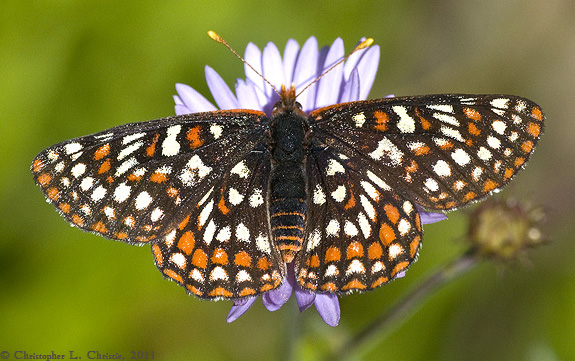 |
| Bay Checkerspot Butterfly Close-Up |
The Bay Checkerspot Butterfly (Euphydryas editha bayensis) is a threatened species which resides mainly in the San Francisco Bay area. It is a subspecies of the Nymphalidae family, and can be distinguished by its red, yellow, and white spots with black bands on its veins and upper wings, and a wingspan of about 2 inches. The insects' life cycle typically spans about one year, and depends largely on the host plants, the main ones being Plantango erecta, Castilleja exserta, and Castilleja densiflora. The emergence, feeding, and mating of the butterflies depends on these plants; without them they cannot lay eggs. Male butterflies can mate multiple times, while females will only mate once (Elam).
 |
| Map of Current and Past Habitats |
Listing
 |
| Italian Rye Grass |
The Bay Checkerspot Butterfly has been listed as a threatened species, since June 18, 1987 (EPA). Although they are not endangered at the moment, the species is likely to become so if current conditions persist. One of the main causes of the listing is habitat loss and degradation brought on by the emergence of non-native plants such as Italian rye grass through nitrogen-deposition. Habitat loss and degradation has also been caused by urban development of the area, freeway construction being on of the largest issues. Smaller populations of bay checkerspots are more susceptible to weather fluctuations such as drought, which has been a common occurrence throughout California in recent years. Overgrazing from livestock has also been a cause for decline, as the animals take away from the butterflies' habitaT (Elam).
Main Threats to Existence
 |
| Metcalf Road near Bay Checkerspot Habitat |
Recovery Plan
The US Fish and Wildlife Service created a recovery plan for the Bay Checkerspot Butterfly in 1998, outlining the following strategy for conservation and survival:
Ways to HelpThe US Fish and Wildlife Service created a recovery plan for the Bay Checkerspot Butterfly in 1998, outlining the following strategy for conservation and survival:
- Vegetation management - Develop techniques to increase survival and reproduction through research into grazing management and biological control.
- Air pollution - Conduct research on nitrogen deposition (and other pollutants) in the populated areas, and develop solutions to reduce/eliminate the affects.
- Habitat restoration - Determine the likelihood of serpentine restoration and implementation methods if possible.
- Artificial rearing - Develop methods of breeding Bay Checkerspot Butterflies in order to produce populations to be reintroduced.
- Nectar resources - Research nectar plants and their relation to survival and success of the insect in the wild.
The steps outlined in the recovery plan are listed in order of priority. Habitat protection and management is crucial to the bay checkerspots' continued existence, and serves as the underlying theme to the strategy (Elam)
 |
| Bay Checkerspot on Native Plant |
Other Resources
Works Cited
1) Elam, Diane R., et al. "Recovery Plan for Serpentine Soil Species of the San Francisco Bay Area" 30 September 1998, pp. 173 - 205. <https://ecos.fws.gov/docs/recovery_plan/980930c_v2.pdf>
2) EPA, "Endangered Species Facts: Bay Checkerspot Butterfly" February 2010. <https://www.epa.gov/sites/production/files/2013-08/documents/bay-checkerspot-butterfly.pdf>
3) Sacramento Fish and Wildlife Office, "Species Information: Bay Checkerspot Butterfly" 6 December 2017. <https://www.fws.gov/sacramento/es_species/Accounts/Invertebrates/bay_checkerspot_butterly/>
4) Friends of Edgewood, "Bay Checkerspot Butterfly" <http://www.friendsofedgewood.org/bay-checkerspot-butterfly>
1
Picture Sourceshttps://www.butterfliesandmoths.org/species/Euphydryas-editha
http://journal.baygeo.org/bay-checkerspot-butterfly/
http://www.mississippi-crops.com/2012/09/10/weed-of-the-week-italian-ryegrass/
http://refugiosanfrancisco.pbworks.com/w/page/11236182/HR_Habitat%20Precedents
http://metroforensics.blogspot.com/2017/08/impaired-driver-58-year-old-thuy-nguyen.html


I really like this blog, I can tell you put a lot of research into it! It is too bad that us as humans are causing the decline by taking away their habitats. This threatened species is right in my backyard and I never knew it. Very informational post! -Michael Avila
ReplyDeleteGreat job on your blog! I was surprised to see that air pollution is one of several threats to this butterfly, I had never considered that when thinking about possible causes of extinction. It was good to see that there are resources near my hometown for helping to plant butterfly gardens and volunteer with local conservation groups to protect this endangered species. - Bailey Barton
ReplyDeleteI think that most people focus on large mammals when they talk about endangerment and extinction and forget that many small insects like butterflies are also in danger. Very interesting and informative! - Zamantha Baraceros
ReplyDeleteI really enjoyed learning about the recover of butterflies. I remember when I was little, I would see so many butterflies migrating. I would even see them wrap their cocoons in my backyard. However, now I barely see butterflies, and I hope for a quick recovery for this insect. -Chris Berridge
ReplyDeleteI like how people have the opportunity to personally help with the conservation of this animal by planting butterfly gardens. It seems like a great way to help the species and also educate the public! -Audrey Bolesta
ReplyDeleteThis comment has been removed by the author.
ReplyDeleteI enjoyed reading about the recovery plan. It was very specific and detailed as well. It was interesting to read about how it has become threatened as a result of non-native species and how much they are disturbing their natural habitats.
ReplyDelete-Keaton Bates
Thanks for sharing! My senior project focuses on the Bay Area so I will consider using the native italian grass in my planting design as it could potentially provide habitat for these endangered butterflies! Thanks for the ideas! -Jenna A.
ReplyDeleteI really like how you focus on a species that isn't currently endangered, but will become endangered if things don't change. This really opens peoples eyes on the issues, and leads them to want to prevent this. I like how you offer solutions to the problem as well.- Grant Baldwin
ReplyDeleteGreat job! The Bay Checkerspot Butterfly is a beautiful species and it is unfortunate to see their decline. Hope to see a speedy recovery for these insects. -Guillermo Avilez
ReplyDeleteI didn't know nitrogen would be harmful for the butterflies! Interesting read! Grant Anderson
ReplyDeleteGreat Job. The Bay Checkerspot is a good looking butterfly- Pierson Berry
ReplyDeleteThis is a cool blog that focuses on a species not yet endangered, because it encourages people to fix the problem before it starts. Good structure and post altogether.
ReplyDelete-Shea Blackman